Directed interval: a diatonic step count and a chromatic semitone count (SPEC-INT-1). More...
#include <Interval.h>
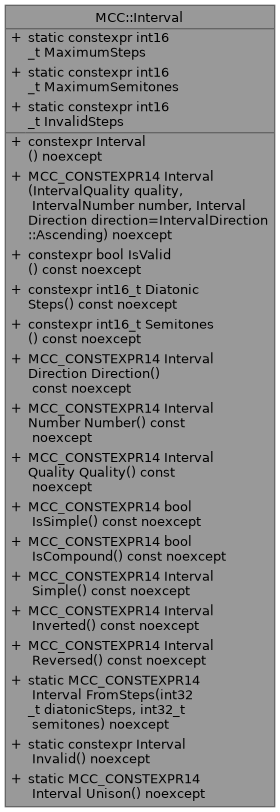
Public Member Functions | |
| constexpr | Interval () noexcept |
| Creates the invalid interval (SPEC-ERR-2). | |
| MCC_CONSTEXPR14 | Interval (IntervalQuality quality, IntervalNumber number, IntervalDirection direction=IntervalDirection::Ascending) noexcept |
| Creates the interval of quality and number in direction, for example Interval(IntervalQuality::Major(), IntervalNumber(3)). | |
| constexpr bool | IsValid () const noexcept |
| Returns true unless this is the invalid interval. | |
| constexpr int16_t | DiatonicSteps () const noexcept |
| Returns the signed diatonic step count, or InvalidSteps for the invalid interval (SPEC-ERR-7). | |
| constexpr int16_t | Semitones () const noexcept |
| Returns the signed semitone count, or 0 for the invalid interval (SPEC-ERR-7). | |
| MCC_CONSTEXPR14 IntervalDirection | Direction () const noexcept |
| Returns the direction (SPEC-INT-2); Unison for the perfect unison and for the invalid interval (SPEC-ERR-7). | |
| MCC_CONSTEXPR14 IntervalNumber | Number () const noexcept |
| Returns the 1-based number (SPEC-INT-2); invalid if invalid. | |
| MCC_CONSTEXPR14 IntervalQuality | Quality () const noexcept |
| Returns the quality (SPEC-INT-4); invalid if invalid. | |
| MCC_CONSTEXPR14 bool | IsSimple () const noexcept |
| Returns true for numbers 1-8 (SPEC-INT-3). | |
| MCC_CONSTEXPR14 bool | IsCompound () const noexcept |
| Returns true for numbers above 8 (SPEC-INT-3). | |
| MCC_CONSTEXPR14 Interval | Simple () const noexcept |
| Removes whole octaves while keeping direction and quality (SPEC-INT-3): a major tenth becomes a major third; an octave stays an octave. | |
| MCC_CONSTEXPR14 Interval | Inverted () const noexcept |
| Returns the inversion of the simple interval, in the same direction (SPEC-INT-6): numbers add up to 9, major and minor swap, augmented and diminished swap. Compound intervals invert their simple part. | |
| MCC_CONSTEXPR14 Interval | Reversed () const noexcept |
| Returns the same interval in the opposite direction. | |
Static Public Member Functions | |
| static MCC_CONSTEXPR14 Interval | FromSteps (int32_t diatonicSteps, int32_t semitones) noexcept |
| Creates the interval spanning diatonicSteps letters and semitones semitones, both signed (SPEC-INT-1). | |
| static constexpr Interval | Invalid () noexcept |
| Returns the invalid interval. | |
| static MCC_CONSTEXPR14 Interval | Unison () noexcept |
| Returns the perfect unison. | |
Static Public Attributes | |
| static constexpr int16_t | MaximumSteps = IntervalNumber::Maximum - 1 |
| Largest step magnitude: IntervalNumber::Maximum - 1. | |
| static constexpr int16_t | MaximumSemitones = 3079 |
| Largest semitone magnitude between two writable pitches. | |
| static constexpr int16_t | InvalidSteps = 32767 |
| Sentinel returned by DiatonicSteps() for the invalid interval (SPEC-ERR-7). Do not rely on it; check IsValid(). | |
Friends | |
| MCC_CONSTEXPR14 Interval | operator+ (Interval a, Interval b) noexcept |
| Adds two intervals by adding their steps and semitones: major third + minor third = perfect fifth. The result is invalid when either operand is invalid or the sum is unrepresentable. | |
| constexpr bool | operator== (Interval a, Interval b) noexcept |
| Written equality: same steps and semitones. An augmented fourth and a diminished fifth are different intervals. All invalid intervals are equal (SPEC-ERR-6). | |
| constexpr bool | operator!= (Interval a, Interval b) noexcept |
Detailed Description
Directed interval: a diatonic step count and a chromatic semitone count (SPEC-INT-1).
Both counts are signed. The direction follows the diatonic steps, or the semitones for a unison, so Cb from C is a descending augmented unison and no diminished unison exists (SPEC-INT-2, SPEC-INT-5). Number and quality are derived from the magnitudes: an ascending major third is +2 steps and +4 semitones; a descending one is -2 and -4.
An interval is valid when its counts lie within the span of writable pitches and its quality is perfect, major, minor, or augmented/diminished at most four times (SPEC-INT-4). Default construction and every other input produce the single invalid value (SPEC-ERR-1..3).
Constructor & Destructor Documentation
◆ Interval()
|
inlinenoexcept |
Creates the interval of quality and number in direction, for example Interval(IntervalQuality::Major(), IntervalNumber(3)).
The result is invalid when the quality does not apply to the number (a perfect third, a major fifth), for a diminished unison (SPEC-INT-5), for direction Unison with anything but a perfect unison, or when either argument is invalid. A perfect unison ignores direction.
Member Function Documentation
◆ FromSteps()
|
inlinestaticnoexcept |
Creates the interval spanning diatonicSteps letters and semitones semitones, both signed (SPEC-INT-1).
The result is invalid when either count exceeds the writable span or the quality would need more than four augmentations or diminutions (SPEC-ERR-3, SPEC-ERR-5).
◆ Inverted()
|
inlinenoexcept |
Returns the inversion of the simple interval, in the same direction (SPEC-INT-6): numbers add up to 9, major and minor swap, augmented and diminished swap. Compound intervals invert their simple part.
An augmented octave inverts to a descending augmented unison, because a diminished unison does not exist (SPEC-INT-5).
The documentation for this class was generated from the following file:
- src/MCC/Interval/Interval.h
Generated by
 1.14.0