Cyclic onset/rest pattern on a grid of equal steps. More...
#include <RhythmPattern.h>
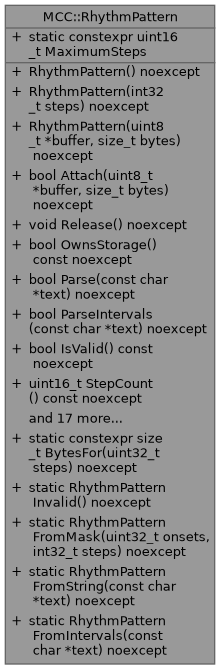
Public Member Functions | |
| RhythmPattern () noexcept | |
| Creates the invalid pattern without storage (SPEC-ERR-2). | |
| RhythmPattern (int32_t steps) noexcept | |
| Creates steps rests in owned storage. | |
| RhythmPattern (uint8_t *buffer, size_t bytes) noexcept | |
| Creates an empty (invalid) pattern attached to buffer, or with owned storage when buffer is null; see Attach(). | |
| bool | Attach (uint8_t *buffer, size_t bytes) noexcept |
| Uses buffer (bytes long) as storage, without owning it. | |
| void | Release () noexcept |
| Releases owned storage or detaches from the attached buffer, leaving the invalid pattern without storage. | |
| bool | OwnsStorage () const noexcept |
| Returns true when the storage is owned (heap) rather than attached. | |
| bool | Parse (const char *text) noexcept |
| Replaces the steps with box notation such as "x..x..x...x.x...". | |
| bool | ParseIntervals (const char *text) noexcept |
| Replaces the steps with interonset intervals such as "3-3-4-2-4". | |
| bool | IsValid () const noexcept |
| Returns true unless this is the invalid pattern. | |
| uint16_t | StepCount () const noexcept |
| Returns the number of steps, or 0 for the invalid pattern. | |
| uint16_t | Capacity () const noexcept |
| Returns how many steps fit without reallocating. | |
| uint16_t | OnsetCount () const noexcept |
| Returns the number of onsets, or 0 for the invalid pattern. | |
| bool | IsOnset (int32_t step) const noexcept |
| Returns true when step, reduced modulo StepCount(), is an onset; always false for the invalid pattern. | |
| int32_t | OnsetStep (int32_t index) const noexcept |
| Returns the step of the index-th onset (0-based), or -1 when index is outside [0, OnsetCount()). | |
| int32_t | InteronsetInterval (int32_t index) const noexcept |
| Returns the steps from the index-th onset to the next one, wrapping around the cycle, or 0 when index is out of range. | |
| bool | SetOnset (int32_t step, bool onset=true) noexcept |
| Makes step step an onset or a rest. | |
| bool | Resize (int32_t steps) noexcept |
| Changes the step count, keeping existing steps and adding rests. | |
| bool | Reserve (int32_t steps) noexcept |
| Ensures Capacity() is at least steps without changing the pattern; false when steps is outside [0, MaximumSteps] or the storage cannot hold it. | |
| bool | Append (bool onset=false) noexcept |
| Adds one step at the end. Owned storage grows geometrically when full; false and unchanged at MaximumSteps or when the storage cannot grow. | |
| bool | Append (const RhythmPattern &other) noexcept |
| Adds other's steps at the end (other may be this pattern); false and unchanged when other is invalid, the result exceeds MaximumSteps, or the storage cannot grow. | |
| bool | ShrinkToFit () noexcept |
| Asks owned storage to shrink to the bytes the steps need, as cpstd::vector::shrink_to_fit() does. Attached storage is left as is. Returns true. | |
| bool | Rotate (int32_t steps) noexcept |
| Starts the cycle steps steps later, in place and without allocating (SPEC-RHY-12). false for the invalid pattern. | |
| bool | Invert () noexcept |
| Swaps onsets and rests in place; false for the invalid pattern. | |
| RhythmPattern | Rotated (int32_t steps) const noexcept |
| Returns the pattern started steps steps later (SPEC-RHY-12). | |
| bool | IsRotationOf (const RhythmPattern &other) const noexcept |
| Returns true when both patterns are the same necklace: equal step counts and some rotation of other equals this pattern (SPEC-RHY-13). Invalid patterns are never rotations. | |
| RhythmPattern | Complement () const noexcept |
| Returns a copy with onsets and rests swapped. Invalid stays invalid. | |
| RhythmPattern | Concatenated (const RhythmPattern &other) const noexcept |
| Returns this pattern followed by other; invalid when either is invalid or the result exceeds MaximumSteps. | |
Static Public Member Functions | |
| static constexpr size_t | BytesFor (uint32_t steps) noexcept |
| Bytes needed to store steps steps; use it to size buffers. | |
| static RhythmPattern | Invalid () noexcept |
| Returns the invalid pattern. | |
| static RhythmPattern | FromMask (uint32_t onsets, int32_t steps) noexcept |
| Creates up to 32 steps from a mask: bit i marks step i. | |
| static RhythmPattern | FromString (const char *text) noexcept |
| Returns a new owned pattern parsed by Parse(), or invalid. | |
| static RhythmPattern | FromIntervals (const char *text) noexcept |
| Returns a new owned pattern parsed by ParseIntervals(), or invalid. | |
Static Public Attributes | |
| static constexpr uint16_t | MaximumSteps = 0xFFFFu |
| Largest step count. | |
Friends | |
| bool | operator== (const RhythmPattern &a, const RhythmPattern &b) noexcept |
| Exact equality: same step count and onsets; storage is ignored. | |
| bool | operator!= (const RhythmPattern &a, const RhythmPattern &b) noexcept |
| Negation of operator==. | |
Detailed Description
Cyclic onset/rest pattern on a grid of equal steps.
The step count is chosen and changed at runtime, from one to MaximumSteps (SPEC-RHY-11). The steps are a Foundation::Containers::BitVector, one bit per step, and follow its storage rules:
- Owned: heap storage that grows on demand. Like a vector, the pattern keeps a step count and a larger or equal Capacity(); changing the step count within the capacity never reallocates, and growing past it lets the underlying cpstd::vector choose the new capacity. Capacity counts whole bytes, so it is a multiple of eight steps (capped at MaximumSteps).
- Attached: a non-null buffer passed to Attach() (or the buffer constructor) is caller-owned storage. The pattern never allocates, reallocates nor frees it; anything that would need more than the buffer returns false and changes nothing. The caller keeps the buffer alive while attached. A null buffer selects owned storage.
Copy assignment, and move assignment into an attached pattern, copy the steps into the existing storage, so an attached pattern stays attached. The operations that return a new pattern (FromString(), Rotated(), ...) own heap storage; their in-place counterparts (Parse(), Rotate(), Invert(), Append()) work inside an attached buffer without allocating.
A pattern may contain no onsets; the invalid pattern has no steps. Allocation failure yields the invalid pattern or a false result that leaves the pattern unchanged (SPEC-ERR-1..4). The pattern is a cycle: step queries are reduced modulo the step count and Rotated() starts the cycle later (SPEC-RHY-12..13).
Like ScalePattern, a rhythm pattern is structure only. It records neither the written value of a step, a meter, a tempo, a clock nor PPQN: the catalog supplies written context and MIDILAR decides when each step plays (SPEC-RHY-14).
Text uses Toussaint's box notation, x for an onset and . for a rest ("x..x..x...x.x..." is the son clave), or his interonset-interval notation ("3-3-4-2-4").
Constructor & Destructor Documentation
◆ RhythmPattern()
|
explicitnoexcept |
Creates steps rests in owned storage.
Invalid when steps is outside [1, MaximumSteps] or storage cannot be allocated.
Member Function Documentation
◆ Attach()
|
inlinenoexcept |
Uses buffer (bytes long) as storage, without owning it.
Releases any owned storage and leaves an empty (invalid) pattern with a capacity of bytes * 8 steps (reported up to MaximumSteps); use Resize(), Append() or Parse() to fill it. The buffer's bytes are written as steps are added. A null buffer returns to empty owned storage instead. Returns false and changes nothing only for this pattern's own owned storage.
◆ FromMask()
|
staticnoexcept |
Creates up to 32 steps from a mask: bit i marks step i.
Invalid when steps is outside [1, 32] or onsets sets a bit at or beyond steps.
◆ InteronsetInterval()
|
noexcept |
Returns the steps from the index-th onset to the next one, wrapping around the cycle, or 0 when index is out of range.
A pattern with a single onset has one interval equal to StepCount().
◆ Parse()
|
noexcept |
Replaces the steps with box notation such as "x..x..x...x.x...".
x or X is an onset and . a rest. Spaces and | are ignored so "x . . x" and "x..x..x.|..x.x..." read as written in the sources. Returns false and changes nothing for any other character, no steps, more than MaximumSteps steps, or too little storage.
◆ ParseIntervals()
|
noexcept |
Replaces the steps with interonset intervals such as "3-3-4-2-4".
Each interval is a positive decimal count of steps from one onset to the next; the first onset falls on step 0 and the intervals sum to the step count. Returns false and changes nothing for malformed text, a zero interval, a sum above MaximumSteps, or too little storage.
◆ Resize()
|
noexcept |
Changes the step count, keeping existing steps and adding rests.
Reallocates owned storage only when steps exceeds Capacity() (to at least the bytes steps needs); shrinking never reallocates. Returns false and changes nothing when steps is outside [1, MaximumSteps] or the storage cannot hold it.
◆ Rotated()
|
noexcept |
Returns the pattern started steps steps later (SPEC-RHY-12).
Step i of the result is step i + steps of this pattern, modulo the step count; negative values start earlier. Rotated(8) turns the 3-2 son clave into the 2-3 clave. Invalid stays invalid.
◆ SetOnset()
|
noexcept |
Makes step step an onset or a rest.
Returns false and changes nothing when the pattern is invalid or step is outside [0, StepCount()).
The documentation for this class was generated from the following file:
- src/MCC/Rhythm/RhythmPattern.h
Generated by
 1.14.0