MCC::Key Class Reference
A tonic and a diatonic mode, with the key signature they imply. More...
#include <Key.h>
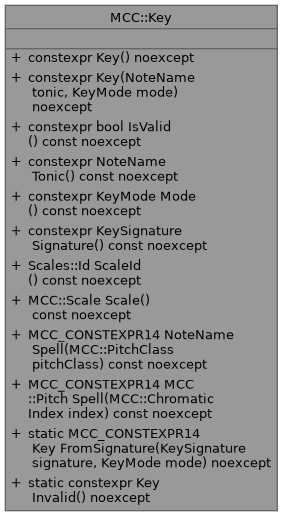
Collaboration diagram for MCC::Key:
Public Member Functions | |
| constexpr | Key () noexcept |
| Creates the invalid key (SPEC-ERR-2). | |
| constexpr | Key (NoteName tonic, KeyMode mode) noexcept |
| Creates tonic in mode; invalid beyond seven sharps or flats. | |
| constexpr bool | IsValid () const noexcept |
| Returns true unless this is the invalid key. | |
| constexpr NoteName | Tonic () const noexcept |
| Returns the tonic. | |
| constexpr KeyMode | Mode () const noexcept |
| Returns the mode. | |
| constexpr KeySignature | Signature () const noexcept |
| Returns the key signature, or the invalid signature. | |
| Scales::Id | ScaleId () const noexcept |
| Returns the catalog scale of the mode, or Scales::Id::Invalid. | |
| MCC::Scale | Scale () const noexcept |
| Returns the key's scale spelled from its tonic. | |
| MCC_CONSTEXPR14 NoteName | Spell (MCC::PitchClass pitchClass) const noexcept |
| Writes pitchClass in this key's context (SPEC-KEY-3). | |
| MCC_CONSTEXPR14 MCC::Pitch | Spell (MCC::ChromaticIndex index) const noexcept |
| Writes a sounding chromatic index as a pitch in this key's context. | |
Static Public Member Functions | |
| static MCC_CONSTEXPR14 Key | FromSignature (KeySignature signature, KeyMode mode) noexcept |
| Returns the key with signature in mode (2 sharps + Minor = B minor). | |
| static constexpr Key | Invalid () noexcept |
| Returns the invalid key. | |
Friends | |
| constexpr bool | operator== (const Key &a, const Key &b) noexcept |
| Compares tonic spelling and mode. | |
| constexpr bool | operator!= (const Key &a, const Key &b) noexcept |
| Negation of operator==. | |
Detailed Description
A tonic and a diatonic mode, with the key signature they imply.
The key is modelled separately from its scale (SPEC-KEY-2): Signature() follows from the tonic's position on the circle of fifths and the mode, and a tonic whose signature would exceed seven sharps or flats (G# major) produces the invalid key. Spell() writes any pitch class in the key's context: diatonic pitch classes use the key's own letters; a chromatic one alters a diatonic note by a semitone, preferring the spelling with fewer accidentals and, on a tie, a raised note in sharp keys and a lowered note in flat keys (SPEC-KEY-3).
The documentation for this class was generated from the following file:
- src/MCC/Key/Key.h
Generated by
 1.14.0